Nuclear bombs (atomic and thermonuclear) are among the most devastating weapons known to man - so you'd hope their handlers would be careful with them! Let's take a look at...
- Fishing for a missing bomb in Palomares
- The potentially nuclear bomb in Tybee
- The dead submarine with nuclear torpedoes
- The plane that crashed into three nukes
- When America (nearly) nuked itself
 |
| Bikini Atoll hosted over 20 tests, ranging from atomic bombs to thermonuclear... (WikiImages) |
Fishing for a Missing Bomb in Palomares
In 1966 two American aircraft collided over Palomares in Spain. This would be a tragedy anyway, but one was a nuclear-armed B-52... and not only did the crash scatter radioactive material over the area, one of the bombs was left unaccounted for.
Military conducting a classified search were at a loss until a local fisherman reported seeing a parachute falling into the ocean after the collision. Since all the servicemen were accounted for, they reasoned that this must have been the parachute-equipped bomb landing in the waters of the Mediterranean.
Recovering the bomb was essential (especially since the USA had agreed not to have nuclear weapons in or over Spain...) so the "Alvin" submersible was deployed to search for the device. It took two months in 50ft visibility, but they eventually found tracks in the seabed marking the path of the weapon as it settled.
Having attached a hook to the bomb, the submersible attempted to pull it to the surface... only for the parachute to unfurl. The massive water resistance from the deployed chute broke the hook, allowing the bomb to tumble back down - which must have tested the intestinal fortitude of the crew.
With the location identified, a naval CURV (cable-controlled underwater recovery vehicle) was able to salvage the bomb by tangling itself in the parachute and lumbering to the surface!
The Potentially Nuclear Bomb in Tybee
Sitting on the bottom of Wassaw Sound near Tybee island in Georgia lies a potentially nuclear bomb. It was a MK15 hydrogen thermonuclear bomb, but the American Air Force claims that no nuclear capsule was onboard... though it was still loaded with conventional explosives and uranium. Worryingly, a declassified report from congress challenges that narrative by claiming it was complete with a nuclear capsule when lost.
The bomb was jettisoned after a F-86 fighter-jet crashed into a B-47. The impact tore a wing from the fighter and damaged the tanks of the bomber - the decision to jettison the bomb was made in case it detonated on landing. A two month long search failed to recover the device, while a later hydrographic sweep suggested the bomb was buried under between 5 and 15ft of silt... where hopefully no-one will disturb it.
The Dead Submarine with Nuclear Torpedoes
The Russian K-8 submarine has to be one of the most ill-fated water-craft out there. Entering service in 1960, the type 627 twin-reactor nuclear-powered submarine suffered a coolant incident almost immediately. The accident exposed several of crew to high levels of radiation and nearly claimed the boat itself.
The defining feature of the 627 was a nuclear torpedo, able to strike naval bases with a 40 kilometer range. They were never really that effective however, as they were so noisy that they could be detected before getting into effective range.
In 1970 K-8 was taking part in a war-game intended to show-off the Soviet navy. The massive set of maneuvers placed K-8 in Bay of Biscay (which ironically enough is a submarine graveyard from WWII) when a pair of fires disabled both reactors. Though damaged and suffering the loss of eight crew, K-8 surfaced and received aid from a Soviet repair boat... but bad weather prevented a successful tow to shore. The crew re-boarded and fought a three-day battle against the inevitable, sinking to an unrecoverable depth of around 15000ft with approximately forty crewmen and four nuclear-armed torpedoes on board.
 |
| There have been at least two nuclear "near misses" at RAF Lakenheath... (wal_172619) |
The Plane that Crashed into Three Nukes
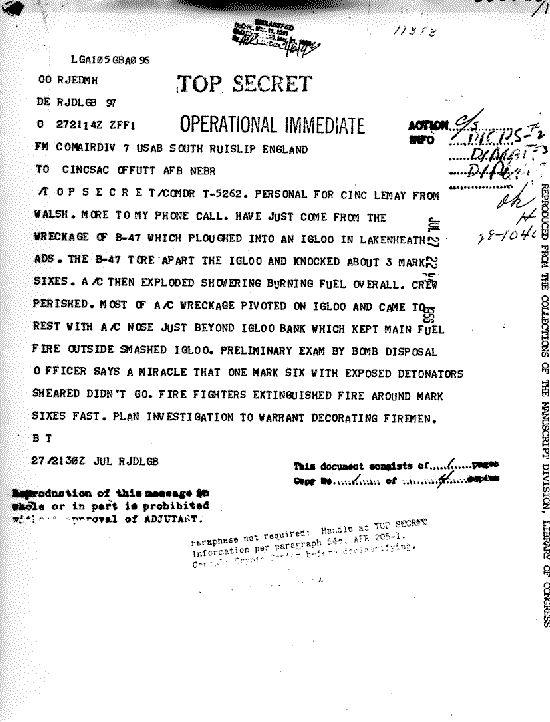
The USA maintains airbases in other countries and has done for a long time. One such base is RAF Lakenheath in the UK, used to store nuclear weapons... albeit not very carefully since it has had at least two near-misses.
In 1956 a B-52 went out of control and ploughed into a "storage igloo" before exploding and showering the area in burning aviation fuel. The igloo was actually holding three nuclear weapons, one of which had the detonators exposed. Only luck and a crew of fire-fighters with nerves of steel stopped the MK6 bombs from detonating. Each had a yield ten times higher than that of Hiroshima.
In 1961 a nuclear armed warplane accidentally jettisoned his fuel tanks, cracking them on the runway. The resulting blaze surrounded the nuclear payload, scorching the bomb but fortunately not setting it off.
For the truly sinister part though, the British government of the time decided that the public didn't need to know about these (and other) near misses, instructing USA officials not to reveal any incidents to the public. Perhaps there's a reason the British tend to be so cynical?
When America (Nearly) Nuked Itself
The MK39 was a fully-fused hydrogen thermonuclear bomb, fitted with multiple parachutes and capable of contact, airburst or lay-down (i.e. parachuting to the ground for a delayed explosion) detonation. They boasted an explosive yield measurable in megatons (enough to obliterate anything within 17 miles of the target) - and but for the flip of a single switch, they would have nuked America.
In 1961 a B-52 bomber armed with two MK39s got into difficulties over Goldsboro, North Carolina. It was airborne as part of Operation: Chrome Dome, a Cold War initiative that kept multiple nuclear-armed bombers airborne at all times... just in case.
Unfortunately this particular aircraft began rapidly leaking fuel, then reported electrical problems before breaking up mid-flight. As the fuselage began spinning and the crew bailed out, centrifugal forces activated the bombing controls. The two bombs were pitched out into the sky around 5000ft above the ground, one slamming 180ft into the ground and the other gently drifting down on the deployed chute.
Neither bomb detonated thanks to safeguard mechanisms, but one had gone through all but one of the detonation steps - the only missing component being the aircraft commander's arming switch. If it had been caught (say, during a frantic attempt to bail out as the burning plane disintegrated around them) it would have detonated!
Thanks for reading - for more, try...